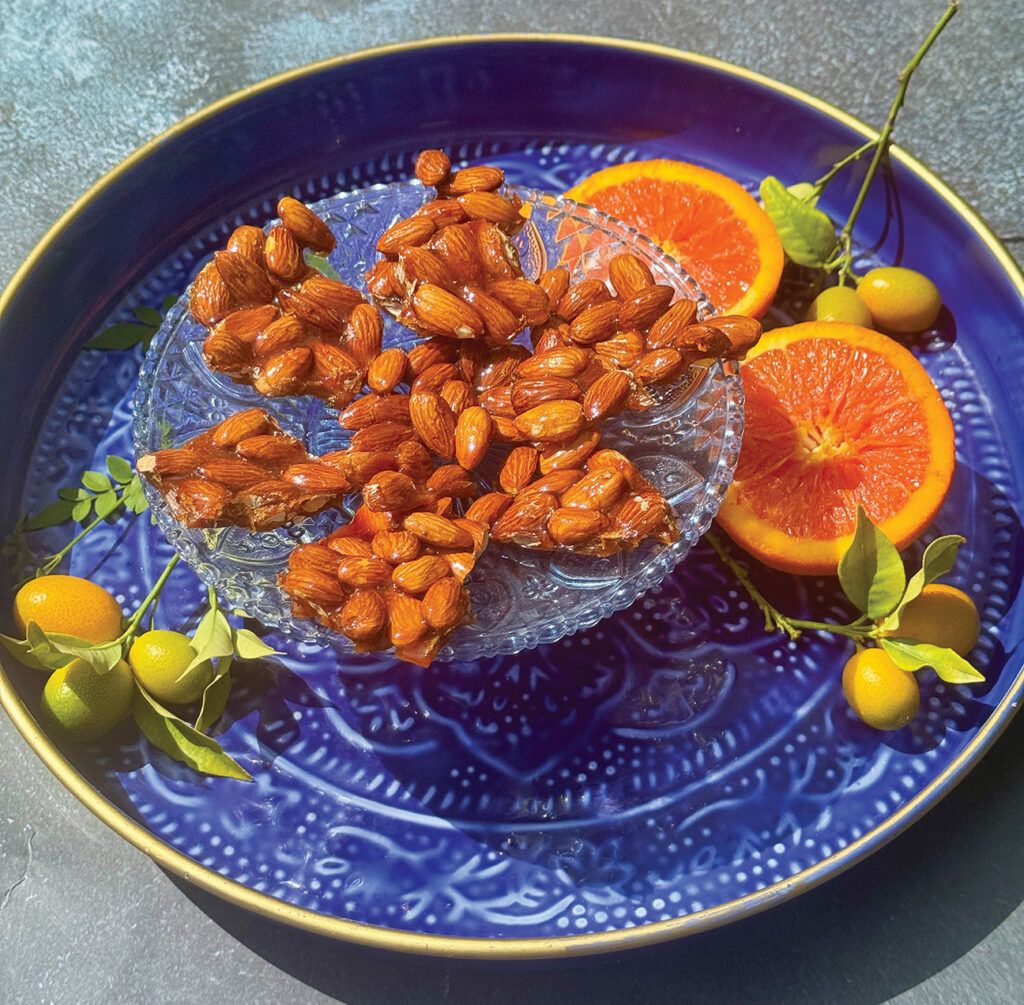
Golden Shards of Almond Croquant
Morocco has always had a deep connection to almonds, where they have grown for centuries and where they are central to many festive foods.
The oil embargo of 1973 and the global economic recession that followed had a direct impact on my family in Sydney, Australia. Mortgage rates skyrocketed and my father had to pivot from buying land and building houses to retailing “schmattes” (the Yiddish word for rags).
The close-knit world of the schmatta business was dominated by Ashkenazi Jews (many were Holocaust survivors). My Uncle Anthony was born into the business — his English emigrant father was a ladies clothing manufacturer and Anthony had his own factory at the age of 20. He very kindly advised my father to sell ladies clothing at the markets. He put his money where his mouth was, giving my father inventory to sell and sending invoices to “Hara Fashions” (if you speak Hebrew, you’ll get the joke).
Many Sunday mornings of my childhood were spent on the long drive to the southwestern suburb of Liverpool. Once there, my father would build a huge stall from interlocking pipes, with a canvas cover to shield the clothes and the customers from the very hot sun. Thank goodness, my parents sold a lot of dresses.
My brother Rafi and I loved the festive atmosphere of the Liverpool market. There was music, food and crowds of happy shoppers and vendors selling trendy t-shirts, jeans, flip flops, toys and home wares. I particularly remember these four loud, plump Italian mamas. They ran a very popular stall with trays and trays of toffee studded with almonds, cashews and peanuts.
This week, Rachel decided to make an Italian almond toffee bark to share with you, dear reader. It was wonderfully crunchy, not too sweet and subtly flavored with a hint of orange. And it transported me to those sweet Sundays at the market.
—Sharon
My mother made a spectacular sesame brittle for special occasions and Jewish holidays, especially Passover. She would stand over the stove melting sugar in a saucepan until it turned the perfect shade of amber and then she would quickly stir in the sesame seeds. Depending on her mood, she would sometimes add roasted almonds to the sesame. Then she would pour the hot mixture onto a tray and spread it thin. Within minutes, we had a crunchy sweet treat. It was so irresistible that it was impossible to stop nibbling!
At the time, I didn’t realize that this very simple candy belonged to a much larger Mediterranean story.
Long before refined sugar became widely available, Arab confectioners were masters at cooking honey with nuts, sesame seeds and fragrant ingredients like orange blossom water. These techniques traveled widely and helped shape many of the desserts we still see around the Mediterranean today, from Morocco to Spain, Italy to Greece.
Sicilian almond brittle, known as croccante or cubbàita, is thought to come from sweets introduced during the centuries of Arab rule.
Morocco has always had a deep connection to almonds, where they have grown for centuries and where they are central to many festive foods. Almond pastries and mazapan are staples of Moroccan celebrations, so it’s not surprising that crunchy almond sweets developed alongside them.
Nuts and honey traditionally symbolize abundance and sweetness, making these treats especially fitting for festive occasions.
If you travel around the Mediterranean, you’ll find close cousins of the brittle my mother made. In Greece, there is sesame and honey pasteli. In Italy, almond croquant appears at festivals and holiday markets. Spain has almond sweets related to turrón. In Georgia, there is honey-nut gozinaki. Iranians have a nut toffee known as sohan asali.
Inspired by the brittle my mother used to prepare for our holidays, I decided to make my own homemade version of the almond croquant scented with orange zest that I had tasted in Italy. Italians often add the zest of an orange to their brittle at Christmas, and the flavor is subtle but unmistakable.
I caramelized sugar the way my mother did, stirred in toasted almonds and added orange zest. I spread it onto a cookie sheet and pressed it between two parchment sheets, then used a rolling pin to flatten it out. Once it cooled and hardened, I broke it into uneven shards. The resulting candy was delicious, the almonds rich and nutty, the caramel deep and slightly bitter, and the orange lifting everything with a bright citrus note. My family finished most of it on Friday night.
It’s funny how a candy made from just a few ingredients can connect so many places. What started as my mother’s sesame brittle turned into something closer to an Italian croquant, but the roots of both stretch across the Mediterranean. Different nuts, different flavors, but the same simple pleasure.
Make sure to make a batch for your Pesach table.
—Rachel
Almond Croquant
3 cups raw almonds
2 cups granulated sugar
Zest of 1 large orange
Olive oil, to brush on parchment paper
Roast almonds at 350°F for 10 to 12 minutes, shaking them halfway through.
In a heavy saucepan, heat the sugar over medium heat. When the sugar has completely melted and is a light amber color, remove from the heat. Add the roasted almonds and orange zest, using a rubber spoon to coat well.
Working quickly, pour the toffee mixture onto the oiled parchment paper. Cover the toffee with another sheet of parchment. Then use a rolling pin to flatten the toffee as much as possible before the sugar hardens.
Allow to cool, then break hardened toffee into pieces and enjoy.
Note:
Melted sugar is extremely hot. Work quickly as it hardens fast. At room temperature, stored in an airtight container, it will stay fresh and crisp for about 1 to 2 weeks.
Can you believe there are people who don’t like chocolate!?
This past Friday night, Alan and I were invited to friends. I didn’t ask what I could bring because, so often, the reply is “bring yourselves.” I thought I was cleverly preempting that issue by stating that I would bring the Israeli salad and flourless chocolate torte that Rachel and I were filming for Instagram.
Our friend’s home was an oasis of calm and artful black and white design. Our small group enjoyed a delicious meal of homemade challah, an Erewhon dupe kale salad, purple cabbage slaw with sesame seeds and a sweet soy dressing, my bright Israeli salad, rosemary chicken, moist, melt-in-your-mouth, barbecue short ribs and white rice. Dessert consisted of fresh berries, a homemade carrot cake (brought by our other friend) and my chocolate torte.
I served torte and berries to everyone. But the hostess declined. “I don’t like chocolate cake,” she said.
What?! Who doesn’t like chocolate cake? Variety is the spice of life. Everyone has a favorite dessert. Every season has its special dessert: think cheesecake for Shavuot, fresh peaches and plums baked into summer cakes, apples and honey cakes for Rosh Hashanah, pumpkin and pecan pies for Thanksgiving.
However, I heartily suggest that you master one or two signature desserts. Along with my cream-and-fruit-topped pavlova, this fabulous chocolate torte is my showstopper. Whenever I bake it for friends, I always receive a torrent of texts asking for the recipe.
Cooking is an art, baking is a science. The most important, most scientific part of this recipe is separating the eggs. Make sure the eggs are cold, so that the yolks don’t break because there can’t be the slightest trace of yellow in the whites. The bowl and whisk must be clean and dry. Let the whites foam up before adding the sugar, then beat those whites into stiff velvety peaks. Use good quality bittersweet chocolate to really elevate the flavor.
This torte is truly worth the effort, and we highly encourage you to add this recipe to your Passover menu. You can easily double the recipe and make two cakes. One for you and one to bring to a friend.
Guess what?
On Saturday night, my friend texted me that she had eaten two slices of the torte over Shabbat!
Wishing you the sweetest endings for all your Pesach meals.
—Sharon
My family are all big lovers of chocolate. I truly believe it all started with my mother. Every night, after dinner, she had to have her chocolate fix, savoring a square of dark chocolate. That was the daily treat with which she rewarded herself.
Ever since my children were little, I only baked for Shabbat. Sweet treats are meant for Shabbat, a celebration of the week that was.
Sharon and I have been making this flourless chocolate torte for many years and this recipe never fails. It’s a cross between a fudgy brownie and a silky mousse with a thin, crackly top.
Everyone really enjoys this rich, dense, chocolatey dessert.
—Rachel
Chocolate Torte
6 large eggs
3/4 cup sugar, divided
1/2 tsp kosher salt
2 tsp vanilla extract
1/3 cup avocado oil
2 Tbsp coffee, cooled
12 oz. bittersweet chocolate chips, melted
Avocado oil, for greasing
Preheat the oven to 335°F.
Line the bottom of a springform pan with parchment paper, then grease the sides with oil.
To prevent the yolks from breaking, use eggs that are still cold from the refrigerator. Separate the whites from the yolks by dividing them into two clean, dry bowls.
Allow the egg whites to come to room temperature. Using a stand mixer, slowly froth the egg whites for 2 to 3 minutes. Gradually add 1/2 cup of sugar and the salt. Continue beating, increasing the speed to maximum, until the whites are very stiff and velvety. Set aside.
Beat the yolks with the remaining sugar, until mixture is a creamy pale yellow. Add the oil and the coffee and continue beating. Add the melted chocolate and slowly beat to combine.
Before the chocolate has time to harden, use a spatula to gently fold in the egg whites. Pour the batter into the prepared pan and bake for 55 minutes.
Allow cake to cool before gently removing from the springform pan.
Decorate with fresh berries or chocolate nonpareils.
Notes:
Tightly covered cake can be stored in the refrigerator for up to five days.
Cake can be frozen for up to two months. Defrost in the refrigerator before serving.
Sharon Gomperts and Rachel Emquies Sheff have been friends since high school. The Sephardic Spice Girls project has grown from their collaboration on events for the Sephardic Educational Center in Jerusalem. Follow them
on Instagram @sephardicspicegirls and on Facebook at Sephardic Spice SEC Food