A Moroccan Journey — My Father’s Life
The name Messod means blessing and good fortune and my father was fortunate to live a life overflowing with both.
In naming my father Messod, my grandparents, who spoke Haketia (a form of Judeo-Spanish) bestowed a blessing of goodness, blessing and good fortune.
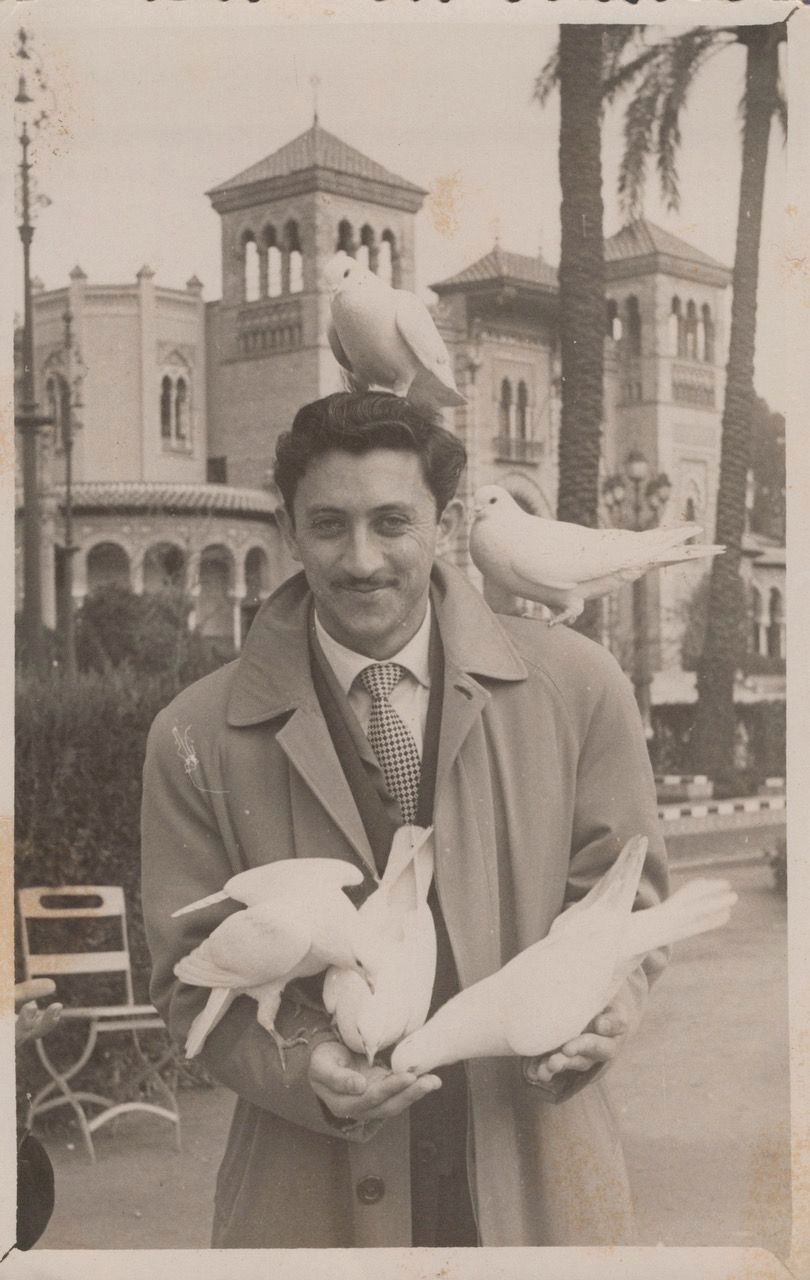
My father was born in 1930 in Larache, an ancient port city in northwestern Morocco. He had an older sister Clara, and three younger brothers, Jacoby, Raphael and Albert.
At 21, he served in the Spanish military. But in classic Papi fashion, he arranged the ideal situation of working in the local military stables and returning to his parents home for dinner every night. He had an uncanny ability to navigate life with intelligence, charm and confidence.
He fell in love with a young lady named Rica, the beautiful younger sister of his closest friend, Yousito Bensabat. After dating for a few years, her family were leaving for Israel. They gave him an ultimatum: marry her or she comes with us. My father married her.
After settling in Casablanca, my parents welcomed my brother Salomon and a few years later, my brother Moise. My father worked a major cheese importers in Morocco. Looking for economic opportunity, my parents moved to Andorra, where he worked as an accountant for a chocolate distributor. But it was too cold and too lonely.
Upon return to Casablanca, where I was born, he worked for my uncle Menasse at Chemise Libaron, a company that produced dress shirts for the King of Morocco and other notable men in Europe.
During those joyful years, our family spent almost every day with Clara and Menasse and my cousins, like one big family.
In late 1973, we moved to Los Angeles thanks to my uncle Albert. Arriving with nothing, but my parents worked hard to achieve the American dream. They saw my brothers and I attend college, have fulfilling careers, marry and build families of our own to make them proud.
My parents were dream grandparents. Loving, devoted, giving and always slipping a little cash into their grandchildren’s hands when no one was looking.
My father adored his grandchildren and they adored him. As young adults, they would take him for weekly lunches and spend every Friday night gathered around the family Shabbat table.
His favorite thing was having them in his den, watching TV, napping, laughing, curled up next to him.
I was the youngest and the only girl. When my older brothers left home, I enjoyed something priceless—time alone with my parents. We shared simple pleasures: going to the movies, an obsession with pancakes, many trips and adventures. By the time I was a teenager, they had spent all their energy worrying about my brothers, so I could do no wrong. They supported every dream I had.
My father was a walking miracle, who took over 20 pills a day. When I was 15, he underwent open-heart surgery. His doctor warned us he might live only ten years more. So I lived the next 30 years in fear. But my father loved life too much. He loved people-watching, laughing, fine dining, shopping, and above all, his family.
After my mother passed away, my father and I held tightly to each other. Every night, he would call me to report on dinner and to critique what I should improve next time. When he praised something I had cooked, I felt pure joy.
I am so grateful for my brothers. Moise, who made sure my parents had the best care and the very best of everything. And Salomon, who helped me manage all the appointments, kept the internet running and always made sure Papi had his Netflix ready to watch.
I am so grateful that he got to know his precious great-granddaughter Raquel. The day before he passed, she sat beside his bed, calling him Papi, kissing him and comforting him.
My father was fortunate to live a life overflowing with blessings and good fortune. We were blessed beyond measure to have him in our lives as long as we did.
—Rachel
My father was a gourmet, with a deep love for French and Italian food. Nothing made him happier than a fresh, flaky butter croissant with his cappuccino. He savored his nightly glass of wine and enjoyed a slice of a good cheese to finish a (dairy) meal.
My grandmother and my mother spoiled my father, preparing special dishes just for him and catering to his discerning palate. It was my honor to take over the cooking when my mother was no longer able.
Of all the specialties of the Moroccan kitchen, dafina was his favorite. Whenever I would tell him that I would be making Dafina for Shabbat, his beautiful green eyes would light up. He cherished the memories that this flavorful dish conjured up.
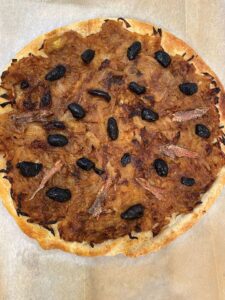
Whenever I was worried that he wasn’t eating enough, I would prepare another dish that always excited him—my onion puff-pastry tart, a simple onion pissaladière. The truth is, he loved anything wrapped in puff pastry!
We hope you enjoy this recipe and pair it with a glass of fine white wine.
L’Chaim!
—Rachel
Onion PissaladiEre
1/4 cup olive oil
3 medium onions, very finely sliced
1 tablespoon fresh or dried thyme
1 teaspoon kosher salt
1/2 teaspoon pepper
1 large garlic clove, crushed
1 tablespoon balsamic vinegar
1 sheet frozen puff pastry
1 can good quality anchovies
1/2 cup oil-cured black olives, pitted and halved
Capers, for garnish
1 egg yolk, beaten for egg wash
In a large pan, warm olive oil over medium heat. Add the onions, thyme, salt, pepper and garlic clove and sauté for a few minutes.
Lower heat and sauté for 45 minutes, stirring every 5 to 10 minutes, until the onions are soft, sweet and browned. Add the balsamic vinegar to the onion mixture and set aside to cool.
Preheat the oven to 450°F.
Place puff pastry on a lightly floured surface and roll the dough into a 10×15 inch rectangle. Place pastry on a parchment-lined baking sheet and use a fork to pierce holes in the center of the pastry.
Bake for 8 to 10 minutes, then remove from the oven. If the pastry has puffed in the center, gently push it down using a rubber spatula.
Spread the caramelized onions in a thin layer, leaving half-inch border all around. Arrange the anchovies and olives in a design. Brush the edges of the pastry with the egg wash. Bake for 10 to 15 minutes until the edges are puffed and golden.
Garnish with capers.
Note: Best served straight from the oven.
Sharon Gomperts and Rachel Emquies Sheff have been friends since high school. The Sephardic Spice Girls project has grown from their collaboration on events for the Sephardic Educational Center in Jerusalem. Follow them
on Instagram @sephardicspicegirls and on Facebook at Sephardic Spice SEC Food.